
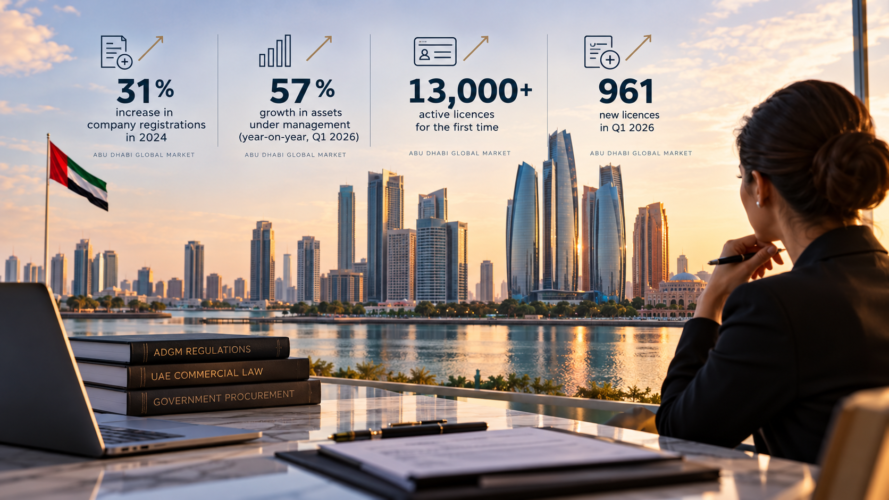
Abu Dhabi’s commercial growth over the past two years has been difficult to ignore. The Abu Dhabi Global Market reported a 31% increase in company registrations in 2024. By the first quarter of 2026, ADGM’s assets under management had grown 57% year-on-year, active licences exceeded 13,000 for the first time, and 961 new licences were issued in Q1 alone. Outside ADGM, Abu Dhabi’s onshore economy continues to attract sustained foreign direct investment across infrastructure, real estate, technology, and financial services.
For the businesses driving that growth, a quieter question has started to come up in legal and finance leadership conversations: is the standard approach to in-house legal resourcing built for how Abu Dhabi operations actually work?
The Resourcing Gap That Most Leadership Teams Recognise
Legal workload does not arrive evenly. It concentrates around contract negotiations, regulatory deadlines, government tender cycles, and compliance reviews. It spikes before a transaction and drops between projects. A fixed in-house headcount manages these peaks and troughs by being either stretched too thin or underused. Often both, in the same quarter.
For businesses in Abu Dhabi, the default response has been to absorb legal work into a Dubai-based team or to instruct external law firms matter by matter. Both carry costs that are not always visible in the moment.
A Dubai-based team covering Abu Dhabi operations is working across two legally distinct environments. ADGM runs under English common law administered by its own courts, separate from the DIFC framework, the UAE mainland civil law system, and the procurement and contracting norms of Abu Dhabi’s government-linked entities. The legal differences are material. A team experienced in one environment does not automatically transfer to the other without a real knowledge gap that creates risk for the business.
A law firm covering each matter on hourly billing is appropriate for complex, one-off work. For the volume of operational legal work that a growing Abu Dhabi presence generates, the cost accumulates quickly and the model lacks the commercial alignment that comes from being inside the business.
What the 2025 Regulatory Environment Has Added
ADGM’s 2025 Commercial Licensing Regulations introduced tighter requirements for legal and corporate service providers operating in the free zone: stricter licensing criteria, governance standards, and mandatory professional standards. The FSRA’s published Business Plan for 2025 to 2026 signals further regulatory development across AML compliance, digital assets, operational resilience, and sustainable finance.
For businesses with ADGM-registered entities, the compliance obligations are more demanding than they were 18 months ago. The expectation is that legal support is current, responsive, and genuinely familiar with the ADGM framework, not plugged in from a Dubai office or brought in on a law firm brief for each individual question.
That environment is prompting a growing number of businesses to look at legal consultants in Abu Dhabi who work within the business on a flexible basis, rather than outside it. The model is not new, it has been well established in the UK and across the GCC for a decade, but the conditions in Abu Dhabi in 2025 and 2026 are the specific conditions that have driven its adoption in other markets.
How the Flexible Legal Model Works in Practice
A flexible legal consultant is a qualified, senior lawyer who works within the business for a defined period or project. Unlike a law firm, they are part of the team. Unlike a permanent hire, the engagement ends when the work does and scales when the workload increases.
For Abu Dhabi operations specifically, this addresses several recurring needs:
- Commercial contract support for agreements with government entities and state-linked organisations (Mubadala, ADQ, ADNOC group companies) where the procurement frameworks, liability structures, and commercial expectations differ from standard private sector contracting
- ADGM regulatory compliance support that reflects the 2025 rule changes, provided by someone who understands the framework in detail rather than interpreting it from first principles on each instruction
- Interim cover when a lawyer in a small Abu Dhabi team leaves or takes planned leave, avoiding the six-to-twelve-week timeline of a permanent replacement process
- An interim General Counsel stepping into a leadership role while a permanent hire is made properly, giving the business continuity and the time to recruit well
The businesses finding this model most practical are not startups. They are multinationals with established Abu Dhabi operations, ADGM-registered professional services firms whose compliance obligations have grown faster than their internal legal capacity, and infrastructure businesses working through Abu Dhabi’s project pipeline. What they share is a legal workload that is genuinely complex, a requirement for lawyers who know the Abu Dhabi context, and a preference for resourcing that reflects how the work actually arrives.
The Cost Structure That Makes It Work
A senior in-house legal hire in Abu Dhabi, fully costed, including salary, end-of-service gratuity, visa sponsorship, housing allowance, medical insurance, and recruitment fees, represents a fixed annual commitment that does not vary with the underlying workload. That overhead makes sense when the legal workload is sustained and predictable at that level. For most businesses in the capital, it is neither.
A flexible legal resourcing model is a variable cost. The business accesses the right level of expertise for the work at hand, scales up during a major procurement or regulatory cycle, and adjusts down between projects. It is a structure that reflects commercial reality rather than working against it.
What Good Looks Like
The model only works if the consultant genuinely knows the market. A lawyer who has spent their career in London or in a Dubai practice will need time to orient themselves to Abu Dhabi’s specific legal environment. That time has a cost, and it falls on the business.
Good provision means consultants with verifiable experience in ADGM’s regulatory framework, UAE employment law and Emiratisation requirements, Abu Dhabi government procurement frameworks, and the commercial norms of working with the capital’s state-linked entities. It means practitioners who can step into the team and contribute from the first week, not the fourth.
A Shift That Makes Sense at This Moment
The flexible legal model has been adopted in markets like the UK and Australia, and across the GCC, as businesses with similar characteristics reached the same conclusion about fixed versus variable legal resourcing. In Abu Dhabi, the conditions that drove adoption elsewhere are now clearly present: a growing base of commercially sophisticated businesses, a regulatory environment that demands specific expertise, and a talent market that makes permanent hiring slow and expensive.
For businesses in the capital reviewing how their legal function is structured, the practical question is less whether the model makes sense and more whether the provider has the Abu Dhabi-specific experience to deliver it well.