
Most people notice technology when it fails. When payments stop processing, platforms go offline, or systems cannot handle demand, the cracks suddenly appear. What often goes unnoticed is the work that prevents those moments from happening in the first place.
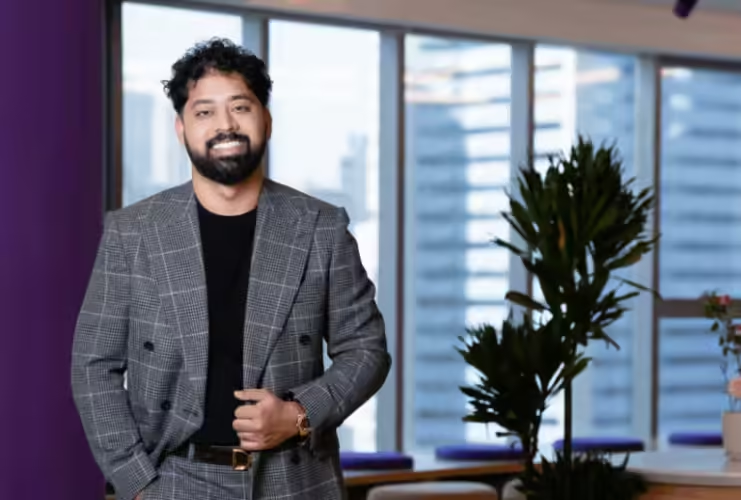
That kind of work sits at the centre of Ehsaan Islam’s career. A technologist and entrepreneur, Ehsaan has spent years building the underlying systems that support finance, education, and intelligent decision-making. His focus is not on flashy features or short-term disruption, but on infrastructure. The kind that holds up when scale, regulation, and real-world pressure collide.
Learning the Cost of Failure Early
Before co-founding platforms used by tens of thousands of people, Ehsaan worked on enterprise systems across the UK. These were not experimental environments. The technology had to work, consistently and securely, often under strict regulatory requirements.
Those years shaped how he approaches engineering. He learned early that weak architecture creates problems that no amount of innovation can fix later. In sectors like finance and education, a system that breaks does more than inconvenience users. It damages trust.
That lesson stayed with him as his career moved from enterprise environments into building his own ventures.
Building BE. with Scale in Mind
When Ehsaan co-founded BE., he did not approach it as a single product or a short-term startup. From the beginning, the goal was to create a platform that could grow into an ecosystem.
As CTO, he designed the technical foundation to support multiple services across fintech and education. Security, modularity, and global scalability were priorities from day one. Rather than adding structure later, it was built into the system from the start.
Today, BE. supports a rapidly growing global user base and continues to expand without needing to rework its foundations. That is not accidental. It is the result of treating infrastructure as a long-term investment rather than a shortcut.
A Practical View of Fintech Innovation
In fintech, innovation is often framed around disruption. Ehsaan takes a quieter, more practical view. He believes real progress in finance comes from platforms that work reliably at scale, especially for professionals who depend on precision.
This thinking is reflected in Sage Master, a strategy platform built for traders who need more than surface-level tools. The platform focuses on performance, reliability, and the ability to handle complex strategies without unnecessary friction.
In 2023, Sage Master acquired Tuned.com, a quantitative trading platform that had processed over six billion dollars in trade volume. Ehsaan led the technical integration, expanding Sage Master’s capabilities while ensuring the combined systems remained stable and secure.
The integration was not just about adding features. It was about strengthening the platform underneath them.
Using AI Where It Actually Helps
Artificial intelligence is often presented as a solution to everything. Ehsaan is more selective. He sees AI as most useful when it supports decision-making rather than replacing it.
DeepSage, an AI-driven decision-support platform, reflects that philosophy. The focus is not automation for its own sake, but clarity. Helping users understand data, model scenarios, and make better-informed choices in complex environments.
In markets where information moves fast and uncertainty is constant, that kind of support can matter more than speed alone.
Education as a Living System
Ehsaan applies the same infrastructure-first thinking to education. He sees learning as an essential part of the digital economy, especially as skills become more closely tied to opportunity.
WOW, an interactive learning network with over 40 live educators, was built to move away from static content. Instead, it focuses on real-time teaching, interaction, and community. Learners and educators connect live, across borders, without the limitations of traditional classrooms.
The idea is simple but powerful. Education should adapt as people grow, not remain fixed in one format.
Why Trust Still Matters Most
Across all of Ehsaan’s work, one theme comes up again and again: trust. Platforms only succeed if users believe their data, time, and capital are being handled responsibly.
That is why security and compliance are treated as core design principles, not obstacles. By building them into the architecture early, platforms can grow without constantly patching weaknesses later.
In an industry that often rewards speed, this approach requires patience. But it also creates systems that last.
The Reality of Being a Modern CTO
Ehsaan’s role goes beyond writing code. As both CTO and co-founder, he operates at the point where strategy meets execution. He translates long-term vision into systems that can actually support it.
This reflects a broader shift in what technical leadership looks like today. Modern CTOs are not just responsible for infrastructure. They help shape the direction of the business itself.
Looking Ahead
As the digital economy continues to expand, the platforms that endure will not be the loudest or the fastest to launch. They will be the ones built carefully, with an understanding of scale, responsibility, and real-world use.
Ehsaan Islam’s work sits firmly in that category. By focusing on infrastructure across fintech, AI, and education, he is helping build systems that quietly enable progress rather than chase attention.
In the long run, those are the systems that matter most.